WHIRLPOOL CORP /DE/ (WHR)·Q4 2025 Earnings Summary
Whirlpool Q4 2025 Earnings: Double Miss as Margins Collapse, Stock Slides 6%
January 29, 2026 · by Fintool AI Agent
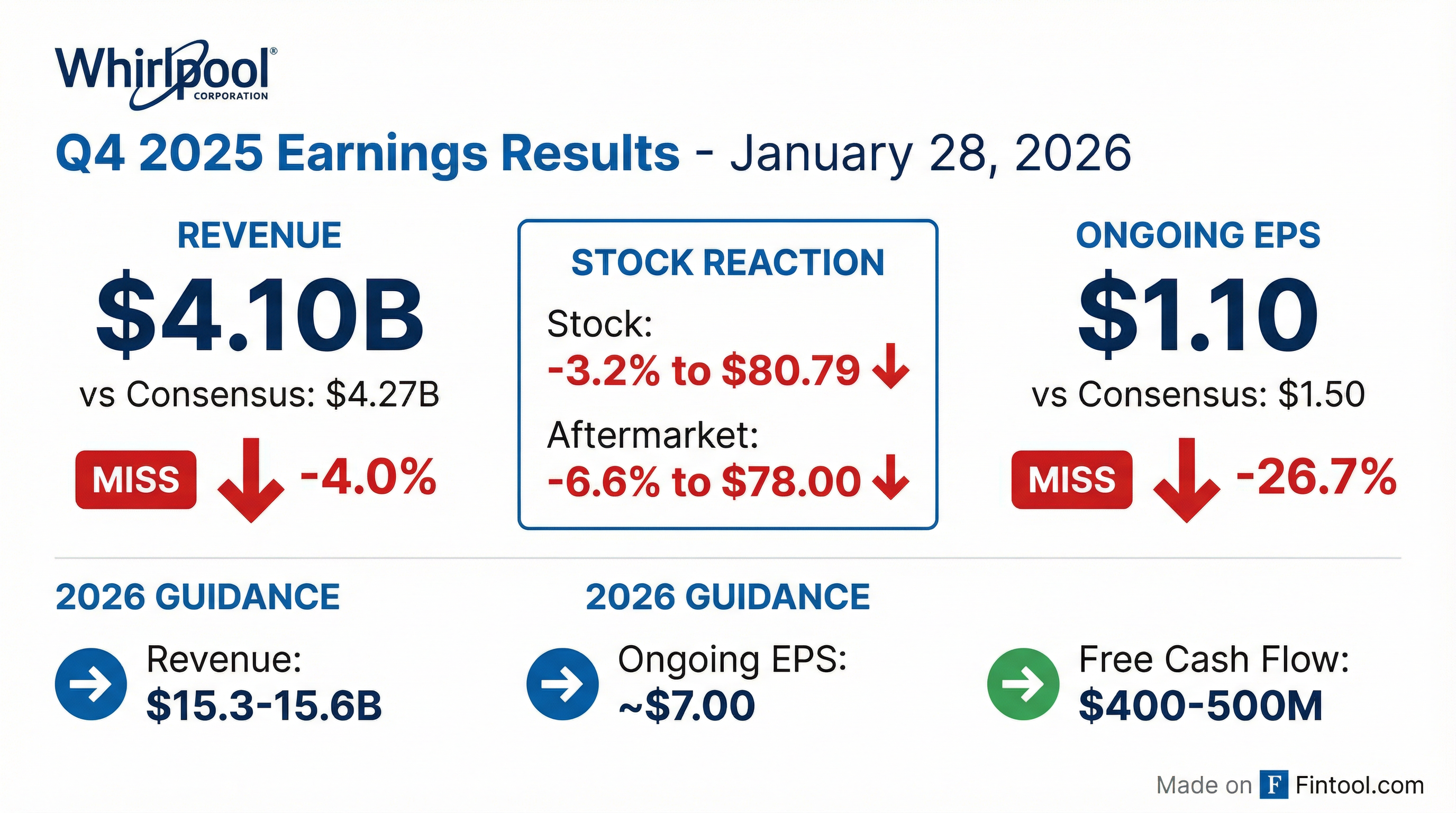
Whirlpool delivered a disappointing fourth quarter, missing both revenue and earnings expectations as margins collapsed under promotional pressure and tariff headwinds. The stock fell 3.2% to $80.79 in regular trading and continued sliding to $78.00 in after-hours trading—a total decline of over 6% from the prior close.
Did Whirlpool Beat Earnings?
No. Whirlpool missed on both top and bottom lines:
The GAAP EPS of $1.91 includes several one-time items: a $251M gain from the India divestiture, offset by a $106M JennAir trademark impairment and $46M in restructuring costs.
This continues a mixed beat/miss pattern for Whirlpool—the company has now missed in 3 of the last 5 quarters on EPS.
 Ask Fintool AI Agent
What Drove the Miss?
Margin compression was the story. Ongoing EBIT margin plunged to 3.3% from 6.0% in Q4 2024—a 270 basis point decline.
CEO Marc Bitzer was direct about the cause: "The promotional environment has not yet reflected the full impact of tariffs."
Key headwinds in Q4:
- Promotional intensity: Competitors continued aggressive discounting despite tariff cost increases
- Volume decline: North America volumes fell, particularly in Canada
- Currency headwinds: FX created a $52M drag on sales
The company did execute $200M in structural cost takeout during 2025 to mitigate tariff impacts, but this wasn't enough to offset the margin pressure.
U.S. Manufacturing Advantage: Management emphasized that Whirlpool's domestic manufacturing position should ultimately be a tailwind. The company produces more appliances in the U.S. than any competitor, uses approximately 96% American steel, and operates some of the largest appliance plants in the world. By contrast, competitors produce only ~25% of what they sell in the U.S. domestically—making them 2-4x more exposed to tariffs.
How Did the Stock React?
Whirlpool shares dropped sharply on the results:
- Regular session: -3.2% to $80.79
- After-hours: Down to $78.00 (additional -3.5%)
- Total decline: -6.6% from prior close
The stock is now trading near its 52-week low of $65.35, down from a 52-week high of $133.45. Year-to-date, WHR is down significantly as the appliance sector faces persistent headwinds from the weak housing market and elevated promotional activity.
What Does the Segment Breakdown Show?
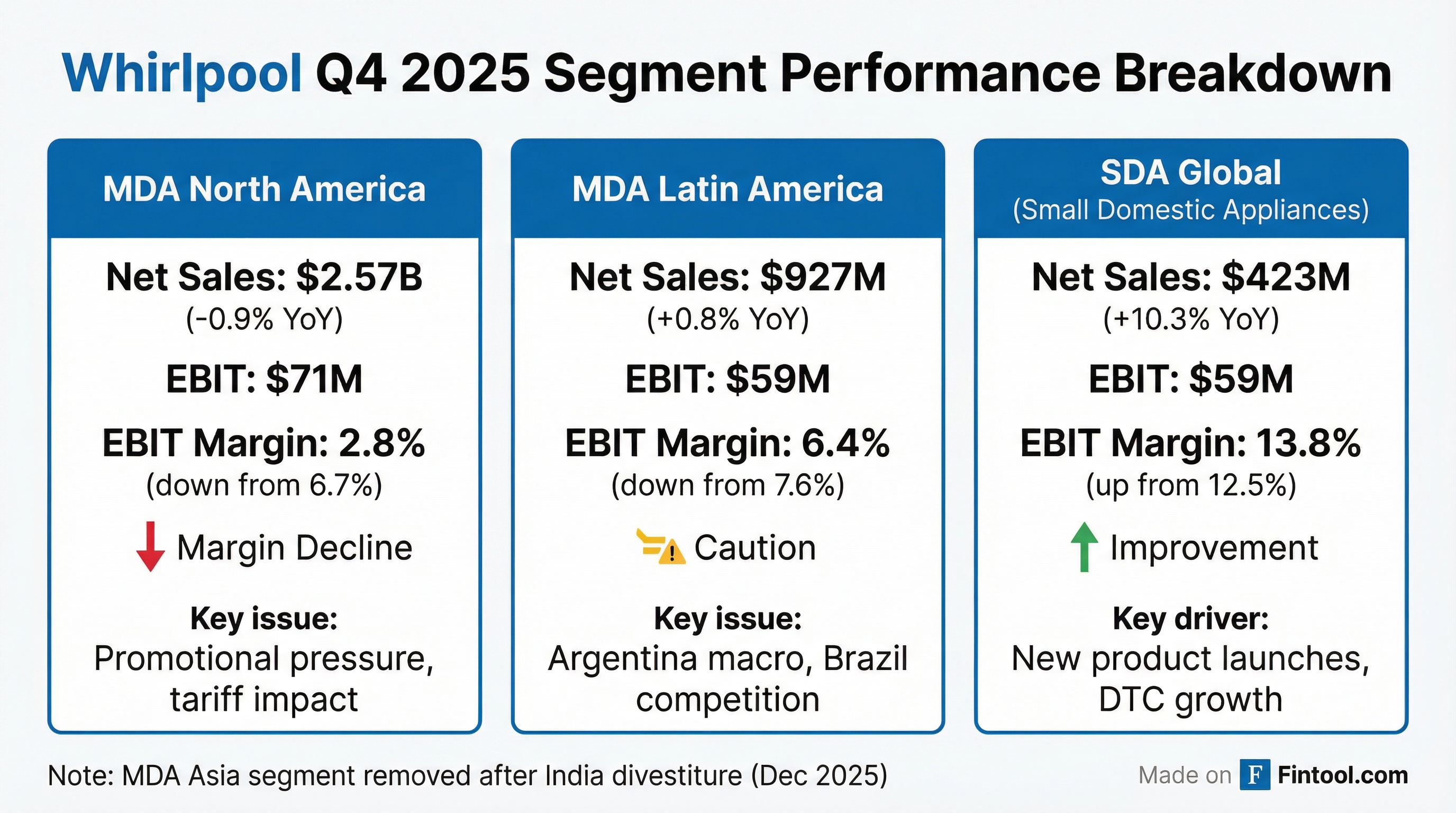
North America (64% of sales): The core business struggled with promotional pressure and volume declines. EBIT margin of 2.8% was less than half of the prior year's 6.7%.
Latin America: Negative macro conditions in Argentina and aggressive competition in Brazil weighed on margins, though a tax reserve release partially offset the decline.
SDA Global (bright spot): Small appliances delivered 10.3% revenue growth excluding currency, driven by successful new product launches and strong direct-to-consumer performance. EBIT margin expanded 130 basis points.
Note: The MDA Asia segment was removed effective December 31, 2025 following the deconsolidation of Whirlpool of India.
Ask Fintool AI AgentWhat Did Management Guide?
2026 guidance was cautiously optimistic, calling for margin recovery and improved free cash flow:
*Like-for-like 2025 sales of ~$14.7B excludes India operations (Jan-Nov)
2026 Segment Guidance
Margin Bridge: How They Get to 5.5-5.8%
*Includes fixed cost takeout, ongoing cost productivity, volume leveraging, and restructuring benefits
Three levers to drive 175 bps of price/mix improvement:
- Reduced promotions: Executing pricing actions in a less promotional industry
- Leverage flooring gains: Build on 30%+ flooring gains from new product launches
- Drive premium mix: Expand premium product offering, fueled by KitchenAid brand
New Product Pipeline
Management highlighted ~100 new products launching in 2026, building on the record 30%+ portfolio refresh in 2025. Key Q1 launches:
- Whirlpool Laundry Tower: Space-saving design with FreshFlow vent system and industry-first UV Clean technology
- Brastemp Refrigerators (Brazil): New top-mount and bottom-mount lineup with improved efficiency
- KitchenAid Compact Grain & Rice Cooker: Tankless design with Precise Pour technology
- KitchenAid Artisan Plus Stand Mixer (March reveal): Described as the "biggest advancements to the Tilt-Head Mixer since 1955"
Four pillars of $150M+ cost takeout:
- Vertical integration to improve quality, speed, and supply chain resilience
- Automation to improve productivity, agility, and safety
- Footprint optimization in manufacturing and logistics
- Strategic sourcing focused on delivering the best solution
Free Cash Flow Bridge
The dramatic improvement from $78M to $400-500M FCF is driven by:
Capital Allocation Priorities
Management laid out clear capital allocation priorities for 2026:
- Fund organic growth: ~$400M capex with ~100 new products launching
- Debt paydown: ~$400M targeted, working toward ~2x long-term net debt leverage target
- Fund dividend: Maintain healthy dividend and return cash to shareholders
- Share buyback/M&A: Not a priority in 2026
Long-Term (Mid-Cycle) Targets
Management also reiterated their long-term targets, which provide context for where they see the business heading:
Notably, management's confidence for 2026 rests on "reduced promotional intensity and a gradual recovery of the housing market" —two factors outside their direct control.
What Did Management Say on the Call?
Leadership Changes
Whirlpool announced three executive promotions, representing over 70 years of combined Whirlpool experience:
- Roxanne Warner → Chief Financial Officer (18 years at WHR, former VP Finance & Corporate Controller)
- Juan Carlos Puente → EVP, North America & Global Strategic Sourcing (30 years at WHR, previously led laundry business)
- Ludovic Beaufils → EVP, KitchenAid Small Appliances & Latin America (20 years at WHR, product marketing background)
Key Management Quotes
On tariff dynamics and competitive positioning:
"As domestic producers, we will ultimately benefit from the tariffs that were put in place... However, in 2025, we absorbed roughly $300 million of tariffs, largely for components and some finished products, but the industry did not yet move on pricing." — CEO Marc Bitzer
On the promotional environment shift:
"The fact that the price is corrected pretty immediately after Black Friday, I would read as an indication that this preloaded inventory is out of the system." — CEO Marc Bitzer
On pent-up demand:
"It's only a question of when, it's not if—there's a multiyear pent-up demand still waiting out there." — CEO Marc Bitzer
Q&A Highlights
Q1 2026 Margin Warning: Management cautioned that Q1 margin will be "clearly below 6%" as they reduce inventory (a drag on margins) while pricing improvements are still building. The 6% North America target is a full-year figure that ramps through the year.
Promotional Pricing Color: Whirlpool uses a "fairly sophisticated price scraping tool" that tracks thousands of in-cart prices weekly. The data shows post-Black Friday prices recovered immediately rather than extending into January as in prior years—a key indicator that preloaded competitor inventory has cleared.
Market Share Dynamics: In Q4, Whirlpool gained share with new products during non-promotional periods but "held ground" during promotional events, consciously choosing not to chase volume with deep discounts. Full-year share was positive, driven entirely by H2 new product momentum.
Cost Takeout Breakdown: Of the $150M+ target, roughly one-third is carryover from 2025 actions. The remainder comes from vertical integration (new initiative), automation, footprint optimization, and a strategic sourcing initiative that Whirlpool last executed 6 years ago with significant savings.
Replacement vs Discretionary Demand: Replacement demand remains elevated at 60%+ of sales (vs ~50% in normal times). This is healthy and stable but lower-margin. Discretionary demand tied to housing/remodeling remains suppressed and is NOT factored into guidance—representing potential upside.
India Stake Evaluation: Management confirmed they are "comfortable" with the 40% minority stake but will "continue to evaluate all options" for additional debt paydown. Other smaller asset sales may also contribute to closing the funding gap between FCF and debt/dividend commitments.
Ask Fintool AI AgentWhat Changed From Last Quarter?
*Estimated from financials data
The sequential margin collapse was dramatic. Q3 2025 showed signs of stabilization with a 50% EPS beat, but Q4 erased those gains. The promotional environment intensified into the holiday season despite tariff cost pressures.
Key strategic developments:
- India divestiture completed: Reduced ownership stake to ~40%, generating proceeds used for debt reduction
- JennAir impairment: $106M writedown indicates brand portfolio challenges
- New CFO: Roxanne Warner stepped into the CFO role and emphasized working capital efficiency as a 2026 priority
What Are the Key Risks?
1. Tariff exposure remains elevated: The company proactively managed $200M in cost takeout, but promotional dynamics haven't adjusted to pass through tariff costs. If competitors continue absorbing costs, margins will stay compressed.
2. Housing market dependency: Existing home sales are at a 30-year low, suppressing the discretionary demand that drives higher-margin appliance purchases. Management cited a ~3 million home undersupply since the financial crisis and existing homes with a median age over 40 years—structural factors supporting eventual recovery, but timing remains uncertain.
3. Balance sheet pressure: Despite debt reduction plans, net debt remains elevated with $5.6B in long-term debt against $669M in cash.
4. Brand value erosion: The JennAir impairment follows a $381M Maytag impairment in Q4 2024, suggesting ongoing brand portfolio challenges.
Ask Fintool AI AgentFull-Year 2025 Summary
The 49% decline in ongoing EPS reflects the challenging operating environment. Organic sales were essentially flat, but profitability deteriorated significantly as the company absorbed higher costs while facing pricing pressure.
The Bottom Line
Whirlpool's Q4 miss underscores the difficult operating environment for appliance manufacturers. Despite record product launches and $200M in cost actions, the company couldn't overcome aggressive promotional dynamics and tariff headwinds.
Management's 2026 outlook assumes promotional rationalization and housing market improvement—two assumptions that require favorable external developments. The ~$7 EPS target represents a meaningful recovery, but execution will be key given the margin pressure evident in Q4.
With the stock trading near 52-week lows and the aftermarket pointing to further weakness, investors appear skeptical that the turnaround will materialize as quickly as management hopes.
Next Catalyst: Q1 2026 Earnings (expected late April 2026)
Related: WHR Company Profile | Q3 2025 Earnings | Latest WHR Documents